

Physical geographical features are the natural landforms and bodies of water shaped by Earth’s forces over millions of years, including mountains, rivers, valleys, oceans, and deserts. These features form the incredible landscape around us and influence everything from weather patterns to where people build their homes.
Have you ever wondered why some parts of the world have towering mountains while others are flat as a pancake? Or why certain rivers wind like snakes while mountains rise straight up? Understanding physical geography helps answer these questions and reveals the amazing story of how our planet works.
Every time you climb a hill, splash in a stream, or build a sandcastle at the beach, you’re experiencing physical geography firsthand. These natural features aren’t just beautiful to look at. They affect the climate in different regions, determine which plants and animals can live there, and even shape human history by creating natural barriers or trade routes.
Learning about physical geographical features opens up a new way of seeing the world around you. Whether you’re gazing at a mountain range, crossing a river, or exploring a coastline, you’ll start to notice the incredible variety of Earth’s natural landscape. Get ready to discover how volcanoes erupt, why deserts are so dry, and what makes an island different from a peninsula.
What Are Physical Geography Features?
Physical geography features are all the natural parts of our planet that nobody built or made. Think of them as Earth’s own special decorations! These are things like tall mountains that touch the clouds, winding rivers that flow through the land, vast oceans full of salty water, hot sandy deserts, and thick green forests where animals live.
The coolest thing about these features? They were all created by nature itself, not by people. When you look at a skyscraper or a bridge, those are made by humans. But when you see a mountain or a beach, those are physical geography features that Earth made all by itself over millions of years!
These natural wonders are found everywhere on our planet. Some countries have towering mountain ranges, while others have flat plains that stretch as far as you can see. You might visit five amazing places around the world and discover completely different physical features in each one.
Understanding these features helps us learn why different parts of Earth look so different from each other. It explains why some places get lots of rain while others stay dry, why some areas are super cold while others are warm all year round, and why our planet is such an exciting place to explore!
Mountains: The Giants of Earth
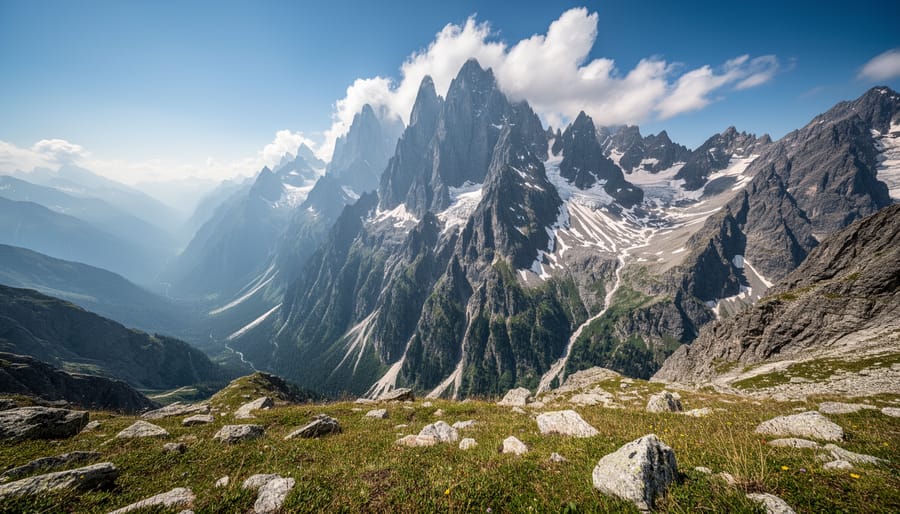
How Mountains Are Formed
Have you ever tried crumpling a piece of paper with your hands? When you push the edges together, the middle rises up into bumps and folds. That’s similar to how many mountains form on Earth!
Our planet’s outer layer is made of huge pieces called tectonic plates, like a giant jigsaw puzzle. These plates are always moving, even though we can’t feel it. When two plates slowly push into each other over millions of years, the land gets squeezed and forced upward. Imagine pushing two blocks together on a table, the edges might buckle and rise. The Himalayas, home to Mount Everest, formed this way from colliding continental crust.
Other mountains are born from volcanoes. Hot, melted rock called magma pushes up from deep inside Earth and erupts, building up layers over time. Mount Fuji in Japan is a beautiful volcanic mountain.
Mountains grow very slowly, just a few centimeters each year. That means they’ve been growing for millions of years to become the towering giants we see today!
Different Types of Mountains
Did you know that not all mountains look the same? Just like how people have different shapes and sizes, mountains come in different mountain types too!
Fold mountains are the most common. Imagine pushing a rug across the floor and watching it bunch up and wrinkle. That’s exactly how fold mountains form when Earth’s surface gets squeezed and pushed together. The Himalayas and the Rocky Mountains are both fold mountains with lots of peaks and ridges.
Volcanic mountains are mountains built by volcanoes. When hot melted rock called lava erupts from deep inside Earth, it cools and hardens into layers that pile higher and higher. Mount Fuji in Japan is a beautiful volcanic mountain with a cone shape, like an ice cream cone turned upside down.
Dome mountains are special rounded mountains that look like giant bubbles pushing up from underground. They form when hot melted rock tries to push through Earth’s surface but stops before breaking through, creating a smooth, dome-shaped bump instead.
Rivers: Nature’s Flowing Highways
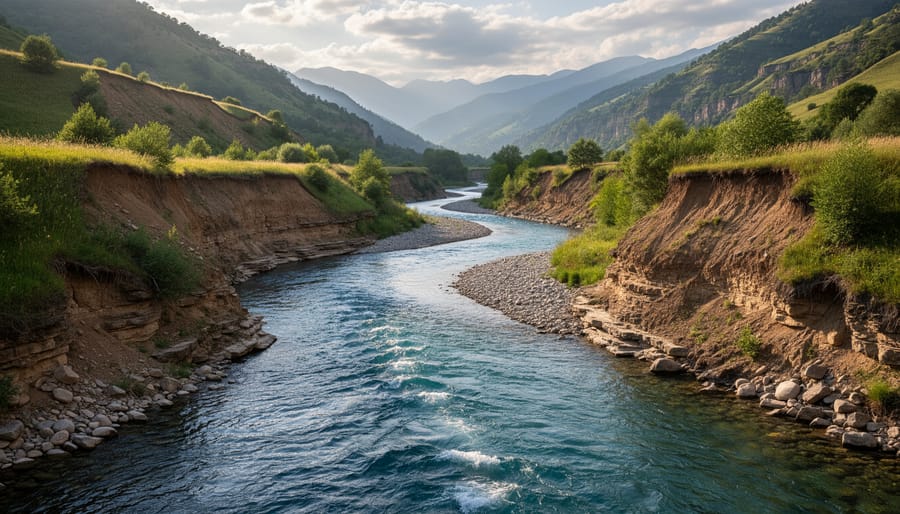
The Longest Rivers on Earth
The world’s longest rivers are incredible water highways that stretch for thousands of miles! The Nile River in Africa holds the record as the longest, flowing an amazing 4,132 miles from its starting point all the way to the Mediterranean Sea. That’s like driving across the United States and back again! The Amazon River in South America comes in second place, and here’s something cool: even though it’s not quite as long as the Nile, it carries more water than any other river on Earth. The Yangtze River in China is the third longest and is so important that millions of people live near its banks. These mighty rivers provide water for drinking, help farmers grow food, and are home to countless fish and animals. Some rivers, like the Amazon, are so wide in places that you can’t see the other side!
Oceans and Seas: Earth’s Watery Worlds
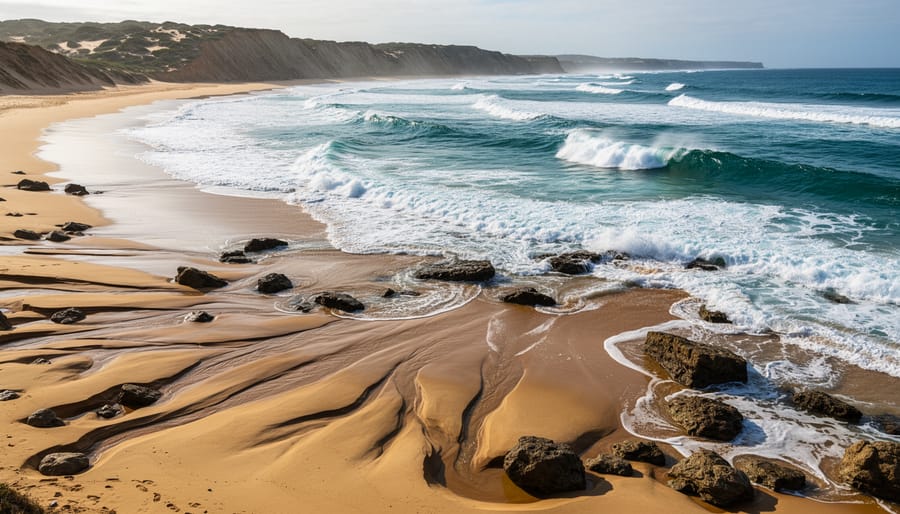
Imagine looking at Earth from space, you’d see way more blue than anything else! That’s because oceans cover about 71% of our planet. These massive bodies of saltwater are the biggest physical geography features on Earth, and they’re all connected like one giant swimming pool.
Our planet has five oceans, and each one has its own special characteristics. The Pacific Ocean is the biggest, so huge that all the land on Earth could fit inside it! The Atlantic Ocean sits between the Americas and Europe and Africa. The Indian Ocean is known for its warm waters. The Arctic Ocean surrounds the North Pole and stays frozen for much of the year. The Southern Ocean circles Antarctica at the bottom of the world.
| Ocean Name | Size | Fun Fact |
|---|---|---|
| Pacific Ocean | Largest (about 63 million square miles) | Deeper than Mount Everest is tall! |
| Atlantic Ocean | Second largest (about 41 million square miles) | Gets a tiny bit wider every year |
| Indian Ocean | Third largest (about 27 million square miles) | Warmest ocean with beautiful coral reefs |
| Southern Ocean | Fourth largest (about 8 million square miles) | Home to penguins and icebergs |
| Arctic Ocean | Smallest (about 6 million square miles) | Covered with ice year-round |
Seas are smaller areas of saltwater, often partly surrounded by land. The Mediterranean Sea, Caribbean Sea, and Red Sea are examples. Think of seas as the ocean’s neighbors, they’re connected but have their own names because of where they sit on the map. All this water moves in currents, like invisible rivers flowing through the oceans, carrying warmth and nutrients around the world.
Deserts: The Dry and Sandy Places
Deserts are some of the driest places on Earth! These special areas get very little rain each year, sometimes less than 10 inches. That’s about as tall as a ruler! Because there’s so little water, deserts have unique plants and animals that have learned clever ways to survive.
When you think of a desert, you might picture hot sand dunes and blazing sunshine. Many deserts are like this, such as the Sahara Desert in Africa, which is the largest hot desert in the world. The sand can get so hot during the day that you could fry an egg on it!
But here’s a surprise: not all deserts are hot and sandy! Some deserts are incredibly cold. Antarctica is actually the largest desert on Earth because it receives very little precipitation. Instead of sand, it’s covered in ice and snow. Cold deserts also exist in places like the Gobi Desert in Asia, where winters can be freezing.
Rocky deserts are another type, where the ground is covered with stones and pebbles instead of sand. The plants that grow in deserts, like cacti and tough shrubs, have special features to save water. Some animals, like camels and desert foxes, only come out at night when it’s cooler. Deserts might seem empty, but they’re full of amazing life!
Forests and Jungles: Green Wonders
Forests and jungles are like Earth’s green blankets! These amazing places are covered with thousands and thousands of trees growing close together. When you walk through a forest, you’ll see tall trees reaching toward the sky, plants growing on the ground, and animals making their homes everywhere you look.
There are different types of forests around our planet. Rainforests are super special because it rains there almost every day! These forests are packed with colorful birds, monkeys swinging through branches, and more types of plants than you can count. The trees grow so close together that their leaves form a thick roof called a canopy.
Deciduous forests are different. They’re filled with trees that drop their leaves in autumn and grow new ones in spring. You might have walked through one of these forests and crunched fallen leaves under your feet! These forests change colors beautifully throughout the year.
Forests give us clean air to breathe, homes for countless animals, and they help keep our planet healthy and cool.
Valleys and Plains: The Flat and Low Areas
Valleys are low areas of land that sit between hills or mountains, like a dip in the ground. Imagine walking between two tall buildings and looking up at them on either side. That’s what a valley feels like! Rivers often flow through valleys because water naturally travels to the lowest spots.
Plains are super flat areas of land that stretch out like a giant pancake. When you stand on a plain, you can see really far in all directions because there aren’t many hills or mountains blocking your view. The Great Plains in North America are so flat and wide that they seem to go on forever.
Both valleys and plains are incredibly important for people. Their flat or gently sloping ground makes them perfect for growing crops like wheat, corn, and vegetables. Farmers love these areas because tractors can easily move across the land. Many towns and cities are built in valleys and on plains too, because the flat ground makes it easier to construct homes, schools, and roads. These features might not look as dramatic as mountains, but they’re some of the most useful places on Earth.
Islands: Land Surrounded by Water
Islands are some of the most exciting physical geography features you can find on Earth! An island is a piece of land that has water completely surrounding it on all sides. Islands can be tiny, like a small rock poking out of the ocean, or absolutely huge, like Greenland, which is the world’s largest island. Some islands are so big that millions of people live on them!
Islands form in different fascinating ways. Volcanic islands are created when underwater volcanoes erupt and build up so much lava that it rises above the water’s surface. The Hawaiian Islands formed this way over millions of years! Other islands used to be connected to the mainland but got separated when water levels rose or the land changed shape.
You might recognize some famous islands that even geography experts find fascinating. Madagascar, off the coast of Africa, is home to animals found nowhere else on Earth. Great Britain is an island where England, Scotland, and Wales are located. Japan is actually made up of thousands of islands! The Maldives are coral islands so flat they sit barely above sea level, making them look like they’re floating on the ocean.
Test Your Knowledge: Physical Geography Trivia Time!
Ready to test what you’ve learned about Earth’s amazing physical geography features? Let’s play a fun trivia game to see how much you remember from our adventure together! Don’t worry if you don’t get everything right the first time, learning about our planet is all about exploring and discovering new things.
Which is the tallest mountain on Earth?
Mount Everest is the tallest mountain, reaching about 29,032 feet into the sky. It’s like stacking more than 20 Empire State Buildings on top of each other!
What are the five oceans called?
The five oceans are the Pacific, Atlantic, Indian, Arctic, and Southern oceans. Together, they cover more than 70% of Earth’s surface with water.
Can deserts be cold as well as hot?
Yes! Antarctica is actually the largest desert on Earth, even though it’s covered in ice and snow. Deserts are defined by how little rain they get, not their temperature.
Where do rivers usually end their journey?
Most rivers flow into oceans or seas. Some rivers also empty into lakes or join together with other rivers along the way.
How did you do? If you want to challenge yourself even more, try asking family members these questions or drawing pictures of your favorite physical geography features. You can also explore more geography trivia to become a real geography champion! Remember, every scientist and explorer started by asking questions and being curious about the world around them, just like you’re doing right now.
Wow! You’ve just explored some of the most amazing physical geography features on our incredible planet Earth. From towering mountains that touch the clouds to flowing rivers that travel thousands of miles, from vast oceans covering most of our world to dry deserts and lush green forests, you now know about the natural shapes and places that make our home so special.
Remember, every time you see a hill, walk beside a stream, or visit the beach, you’re experiencing physical geography in action. The world around you is full of fascinating features waiting to be discovered.
Keep asking questions about the places you see. Why does that river curve? How tall is that mountain? What lives in that forest? Your curiosity is the best tool for learning about our amazing Earth.
For parents and teachers, making geography exciting through trivia games, outdoor exploration, and interactive learning helps children develop a lifelong love of our natural world. When we make learning fun, children remember what they discover and want to learn even more. Keep encouraging young explorers to look closely at the world around them and celebrate every new discovery they make about our wonderful planet!