
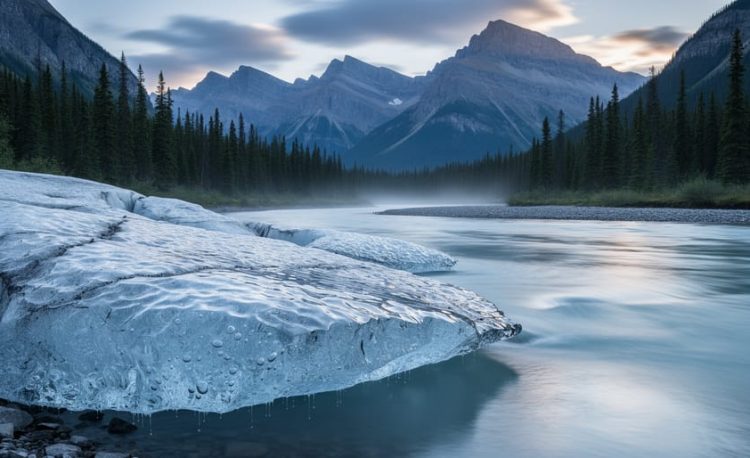
Climate change is the long-term shift in Earth’s usual weather patterns, mostly caused by people adding extra heat-trapping gases to the air. Think of it like wrapping the planet in a thicker blanket. A little warmth is cozy, but too much changes everything underneath.
Why does it matter for you? Because it’s already showing up on our maps. Canada’s Changing Climate Report 2026, published by Environment and Climate Change Canada, found that Canada warmed by an estimated 2.0°C between 1948 and 2023. Canada’s North warmed even more, by 2.6°C. Newer temperature indicators that run through 2025 show a 2.3°C warming trend across the country.
Ready to explore? In this article, we’ll unpack how climate change works, spot the signs in glaciers, rivers, and mountains, and try some hands-on activities. Can you guess which part of Canada is warming fastest? Keep reading to find out!
What Climate Change Means in Plain Words
Imagine you wake up and it’s raining. That’s weather! Weather is what’s happening outside today: sunny, rainy, windy, or snowy. Climate is the usual pattern of weather in a place over many, many years.
Here’s a fun way to remember it: weather is your mood today, and climate is your personality. You might feel grumpy on a Monday, but that doesn’t mean you’re a grumpy person. In the same way, one cold day doesn’t change the climate of a place.
So what is climate change? It’s a long-term shift in those usual weather patterns, for one place or for the whole planet. Scientists look at many years of measurements, not just a single day or season, to spot these shifts. Global warming is one part of that bigger story. It means the average temperature of our planet is going up. If you’re curious how the two ideas fit together, you can read more about global warming vs climate change and when people use each term.
Here’s a tiny glossary to keep handy:
- Weather
- What the air and sky are doing right now, like rain, sun, or wind.
- Climate
- The usual weather of a place over many years.
- Climate change
- A long-term shift in the usual weather patterns of a place or the whole planet.
- Global warming
- The rise in the average temperature of the Earth over time.
- Greenhouse gases
- Gases in the air that trap the Sun’s heat, a bit like a blanket.
Ready to test your brain? Try this mini-quiz: “It’s snowing outside my window right now.” Is that weather or climate? And what about “Winters in northern Canada are usually very cold”? Think it over, then check your answers with a grown-up or a friend!
How Our Planet Warms Up: The Blanket Around the Earth
The Greenhouse Effect, Explained with a Blanket
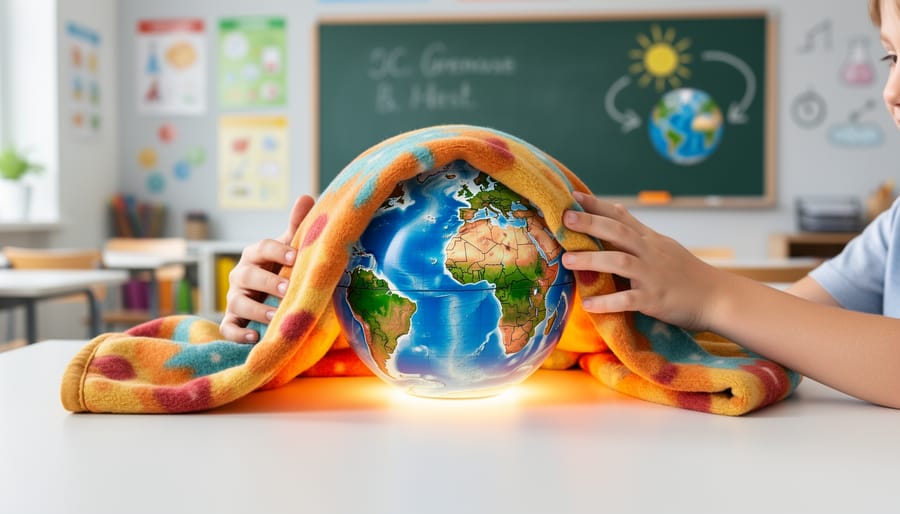
Imagine pulling a cozy blanket over yourself on a chilly night. The blanket doesn’t make heat. It just keeps your own warmth from escaping. The Earth works in a similar way.
The Sun’s light warms our planet, and the Earth sends some of that heat back up toward space. But certain gases in the air, called greenhouse gases, act like a blanket. They catch some of the heat and hold it close, which keeps our world warm enough for plants, animals, and people to live.
A little blanket is wonderful. Without it, Earth would be freezing cold. But what happens if you pile on a second blanket, then a third, then a fourth? You’d get too warm! When extra gases build up in the air, the Earth’s blanket gets thicker, and more heat stays trapped.
Can you think of a time you felt too snug under a pile of covers?
Where Do the Extra Gases Come From?
Where do the extra gases come from? Let’s play detective!
Think about a busy morning. A car zooms down the road, and out of its tailpipe puffs exhaust. That’s one source. Power plants that burn coal, oil, or gas to make electricity add gases too. So do factories that build the things we use every day. All of these send extra blanket-gases into the air.
Nature makes some gases as well. Volcanoes puff them out, and rotting leaves and plants release them slowly. But the extra gases piling up lately mostly come from people burning fuels.
Can you spot it? Look around your home or classroom. What runs on electricity? What got delivered on a truck? Each one is a clue about where those gases might begin!
Signs of a Changing Climate Around the World
Scientists look for clues that our planet’s climate is shifting, and you can find them almost anywhere on a map. Here are the big ones:
- Warmer temperatures: the air and oceans heat up over many years, which can shrink the ice on tall mountain peaks.
- Melting ice and snow: glaciers and polar ice melt faster than before, and the water flows into rivers and seas.
- Shifting rain and snow: some places get heavier storms while others get drier spells, changing how full rivers and lakes become.
- Changing seasons: spring can arrive earlier and winter can feel shorter along coastlines and in forests.
Let’s take a closer look. Warmer temperatures are the clearest sign. Canada warmed by an estimated 2.0°C between 1948 and 2023, and Canada’s North warmed by 2.6°C over the same time. A degree Celsius is a small step on a thermometer, but a few of them add up across a whole country. If you were a glacier, how would a warmer world feel?
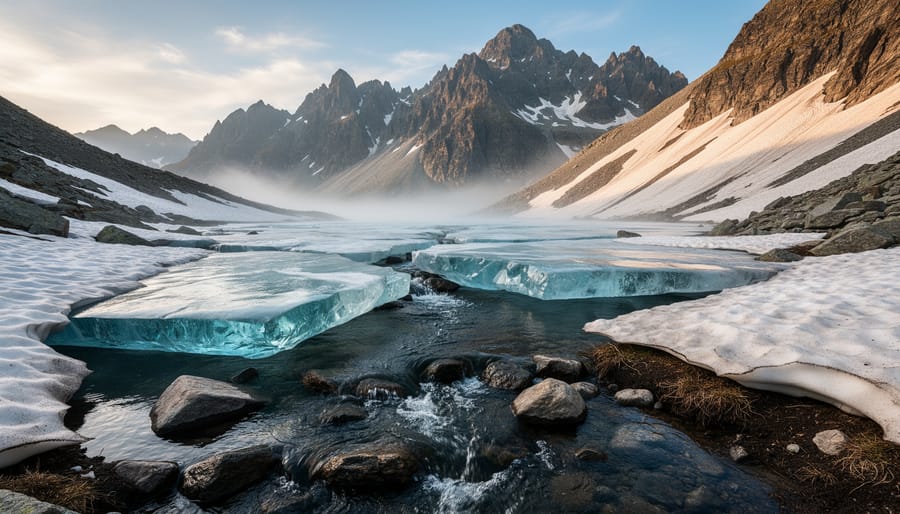
Melting ice and snow connect to the places we love to find on a map. High up in the mountains, glaciers act like frozen rivers, and in polar regions huge sheets of ice cover land and sea. When they melt, the extra water has to go somewhere. Where do you think it ends up?
Rain and snow can change too. Learning how mountains and rivers work together helps us see why. Snow on a mountain slowly melts into streams, so less snow can mean a quieter river in summer. Can you guess which animals might notice a river running low?
Finally, seasons can shift. Flowers may bloom earlier, and snow may arrive later. What changes have you noticed outside your window?
Canada’s Changing Climate Report 2026: What’s New?
Have you heard of Canada’s Changing Climate Report 2026? It’s the second edition of a scientific report that looks at how Canada’s climate has changed in the past and how it might change in the future. Scientists put it together to help everyone understand our planet better. It was published by Environment and Climate Change Canada, part of the Government of Canada, and a short summary shares the main findings in simple form.
How Much Has Canada Warmed?
Let’s look at the numbers! Scientists measure warming in degrees Celsius, the same kind of degrees you see on a weather forecast. A change of one degree might sound tiny, but when it’s the average for a whole country over many years, it adds up.
Here’s what the experts found. Between 1948 and 2023, Canada warmed by an estimated 2.0°C. That’s across the whole country, from the Pacific coast to the Atlantic, and everywhere in between. Think of it like slowly turning up the heat in a giant house, one room at a time, over seventy-five years.
Now for Canada’s North. Over those same years, 1948 to 2023, the North warmed by 2.6°C. That’s a bigger number than the one for the whole country!
The story keeps going, too. The latest Environment and Climate Change Canada temperature indicators now reach all the way to 2025. They show a 2.3°C warming trend across Canada over 1948 to 2025.
Time for a quick brain teaser: Which place warmed more, all of Canada or the North?
Look back at the numbers (2.0°C and 2.6°C) and see if you can work it out. Then grab a map and find the North. What do you notice about where it sits? Why might it warm differently from the rest of the country? That’s exactly the kind of big question real scientists ask!
How People Are Using What We Know About Climate
Scientists use reports like CCCR2026 as a giant puzzle picture. Each study is one puzzle piece, and together they show how Canada’s climate has changed and might change next. That scientific assessment of climate looks at the past and the future, so leaders and communities have solid facts to plan with.
Governments use that knowledge to make choices. As of May 15, 2026, the federal government is updating the headline price trajectory for all industrial carbon pricing systems in Canada. Read the May 15, 2026 update for the official details. In simple words, it’s one way a government tries to nudge big businesses toward cleaner choices. Countries also team up, and you can learn more about how the UN fights climate change around the world.
Communities and families get to join in too. Neighbourhoods plant trees, and families talk about how they use energy at home. Kids have real power here. Which of these could you try this week?
- Switch off lights and screens when you leave a room.
- Walk, bike, or scooter for short trips.
- Reuse and recycle, and see how recycling helps the planet.
- Plant a seed, a flower, or a tree with a grown-up.
- Learn something new about climate and share it with a friend.
- For teachers and parents: host a weather-vs-climate activity at home or in class.
Small actions add up when lots of people do them together. Keep asking questions, because curious kids often become the best climate helpers.
Climate Change Questions Kids and Grown-Ups Ask
Got questions? Here are some of the ones people ask most.
What is Canada’s Changing Climate Report 2026?
It’s a scientific assessment of past and future changes in Canada’s climate, published by Environment and Climate Change Canada. A summary shares the main findings.
What is new in this second edition?
This is the second edition of the report, known as CCCR2026. Environment and Climate Change Canada’s temperature indicators now run through 2025.
How has Canada warmed since 1948?
Canada warmed by an estimated 2.0°C between 1948 and 2023, and the North warmed by 2.6°C. The newest indicators show a 2.3°C warming trend across Canada over 1948 to 2025.
What is the difference between weather and climate?
Weather is what’s happening outside today. Climate is the usual pattern over many years.
What policy change is the federal government making to carbon pricing?
As of May 15, 2026, the federal government is updating the headline price trajectory for all industrial carbon pricing systems in Canada.
Which answer surprised you most? Pick one and share it with a friend or family member!
Big Ideas to Remember
Let’s wrap up the big ideas, explorer! Remember, climate is the long-term pattern of weather in a place, not just today’s forecast.
What will you teach someone else about climate first?
Now that you know how our planet’s blanket works, why not keep exploring? Try a geography quiz or activity here on the site, then look at maps of mountains, rivers, and polar regions to spot where glaciers and ice live. Talk about today’s weather with your family or classmates, and ask what felt different when they were your age.
Parents and teachers, this article makes a handy discussion starter at home or in class. Read a section together, pause at the questions, and let curious minds lead.
So, what will you notice about the weather around you tomorrow?